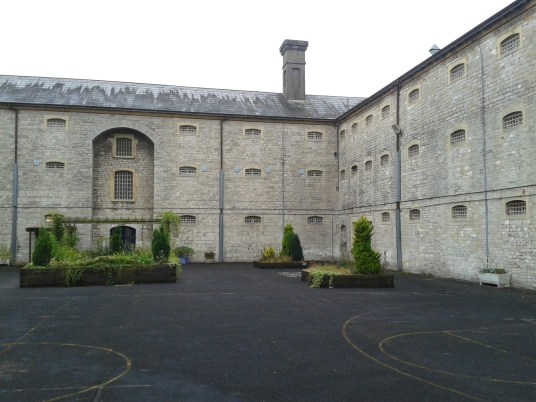
The end of the road? Surely with the planning application for the prison’s redevelopment being refused by the Mendip Planning Board on Wednesday evening this should actually be the start of a new chapter? Not so – for me at least.
My ‘journey’ with Shepton Mallet Prison started a year ago when this picture was taken at the first consultation event I attended. I have learnt so much about the prison (and myself) since then.
What did I learn following the Planning Board meeting on Wednesday (which incidentally I did not attend)? I learnt that many of those who spoke against the housing development and resulted in its refusal don’t actually object to the development at all. The Listed Building application after all was approved. Apparently, the main problem is parking and safety on the local road network.
I don’t actually disagree with the latter. The parking is likely to prove to be inadequate and the narrow local roads have limited pavements. It does indeed feel unsafe to walk along them with a young child.
I don’t, however, think the problems with the development will be solved by finding some extra parking and maybe introducing traffic calming.
This is a truly personal opinion and I totally respect the fact that it is not one others will share – I do actually object to the development.
The concerns about parking and highways are valid because (in my opinion) the site is overdeveloped and the plans do not sufficiently take into account the context in which they are brought forward.
Shepton Mallet is an historic market town with no mainline train station and limited public transport. Many people have to commute many miles to their places of employment. Many people have no choice but to use a car. Some people are lucky enough to be able to walk to work (or can afford not to work). If all of those people are lucky enough to afford a new flat in the prison then I wish them, and the redevelopment, well. If not, then there will be a problem that will persist long in to the future. Unfortunately I do not see the public transport situation improving any time soon.
The development proposals require the demolition of bat roosts, with little thought given to how to accommodate them in the future site proposals. It requires the site to be lit internally and externally – again with little thought to the bat population or surrounding neighbours. Perhaps it will be a good thing if the area feels too dark and unsafe at present – or perhaps people will miss the fact that the area is currently not lit around the clock. I don’t know as I don’t actually live in this part of town. That’s for the prison’s neighbours to decide.
The flats need to be built to cover the costs of the redevelopment. There is no room for ‘affordable housing’. Perhaps the development is so costly because there are so many costly interventions built in to the plans? It cannot be cheap to relocate the bodies of executed prisoners, demolish so many buildings and internal features and build so many new elements. Perhaps housing is not the right answer then? Or perhaps it is and these interventions, the level of redevelopment and the final cost of housing is the price to pay?
The developers make a living from redeveloping historic buildings. Many people will, however, attest to the fact that historic buildings and profit don’t often fit together. It often takes the intervention of trusts, charities and grants to plug the shortfall in cash. Decisions are taken to do this for ‘the greater good’ – there is a reason for doing so beyond profit.
I personally feel that Shepton Mallet Prison has something greater to offer. I believe it opens up a world of opportunities to learn about how we have progressed as a society over 400 years. To learn about crime, punishment and rehabilitation.
400 years ago I would probably have been imprisoned (or worse) for being a woman with strong opinions. I would certainly have been imprisoned for not attending church on a Sunday. Sometimes you need to have reminders of where we have come from – particularly if it means we don’t go back there.
Shepton Mallet Prison has a very grim past. Many people believe this is best forgotten – or left written in a book. The developers have certainly done much in their proposals to help cover things up – open up a new entrance in the walls, build mews in front of them, remove the bodies, demolish the execution chamber, introduce lighting and new landscape planting, have an interpretation area that’s open by appointment only. I totally understand that. Who would want to live in the prison as it is? It’s former inhabitants had no choice. Future paying customers certainly do.
I never expected the site to be completely redeveloped as a heritage site. I do after all live in the real world. I just always hoped that a better balance would be struck. That people would value the heritage of the site rather than simply look to preserve elements of bricks and mortar.
So to conclude, this is the end of the road for me as it appears that it has been decided that housing is an acceptable use as long as the parking is sorted. The interpretation proposals are fine as long as there is a legal agreement to secure them and additional information is provided about what is proposed. The interventions to the Listed Building are already approved.
What more is there for me to say?


