Did you know…?
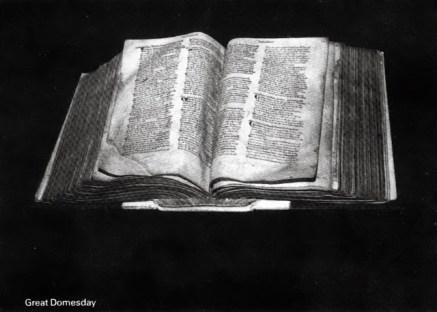
The Domesday Book was held at Shepton Mallet Prison during World War 2.
Francis Disney’s book recounts a wonderful story about the Book’s arrival in our town. Continue reading The Domesday Book comes to Shepton
The Domesday Book was held at Shepton Mallet Prison during World War 2.
Francis Disney’s book recounts a wonderful story about the Book’s arrival in our town. Continue reading The Domesday Book comes to Shepton
There is nothing new about the idea of a prison as a tourist destination. In April 1840 the Bodmin and Wadebridge Railway ran a day trip from Wadebridge – a visit to Bodmin Jail. James and William Lightfoot were to be hanged for the murder of a local man. A crowd of 20,000 gathered to watch the execution. Continue reading Bodmin Jail
Where prisons have been converted to alternative uses they provide a valuable educational resource. For example, the Galleries of Justice Museum in Nottingham provides hands-on learning experiences, bringing the subjects of History and Citizenship to life. Continue reading Learning from 400 years of History
Did you know…?
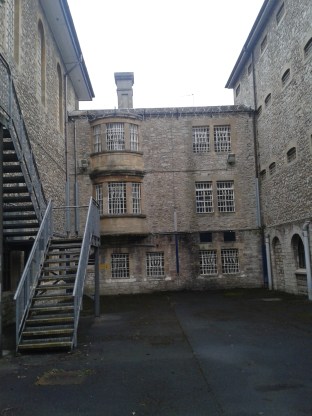
Through publishing our ‘Did you know…?’ stories on this page we have been introducing you to just some of the prison’s fascinating stories and those of the people who worked and were detained there.
Now that the planning application has been submitted it is time to update you on what is happening to each of these elements:
– The Grade II* listed Treadwheel building is to be converted to 4 1-bedroom apartments, with the lower ground floor retained for storage use.
– The Grade II listed walls of the prison will have a new pedestrian opening inserted in the southwest corner of the site. The south and southwest prison walls will be largely obscured from internal view following the construction of two blocks of three storey mews providing 17 apartments with 31 under croft parking spaces. The mews will be higher than the 8m walls, when measured to the ridge of the roof and some will protrude above the walls.
– The Grade II* listed prison buildings will mostly be converted to apartments, with the former visitors’ centre to be used as a café/community/interpretation space along with the retention of 7 cells within B Wing for historic interpretation use.
– The Grade II listed Gatehouse will be open to provide a new pedestrian access to the site.
– The block containing the consecrated prison chapel, the Church of Saint Andrew, will be demolished. It will be replaced by a new five storey apartment block with 23 apartments and 9 parking spaces.
– The workshop building will be converted to 28 apartments and 76 parking spaces. Two floors will be added to the top of the building.
– The execution room built by the US Armed Forces will be demolished.
– A culvert carries a watercourse under the prison into the River Sheppey. C&C propose to divert this.
– You told us about some of the ‘cool’ bits like the carved markings and tallies in the wall in the original holding cells and bullet marks in the prison walls. We understand that these will all be lost/covered up during the redevelopment process.
– The bodies of prisoners executed as recently as the 1920s lie within unmarked graves within the prison walls. We believe these bodies will need to be exhumed to make way for the mews apartments.
So what do you think?
Do City & Country’s plans effectively safeguard the heritage of Shepton Prison for the future? Which features to be lost do you value most and think should be retained?
Do let us know but also please let MDC know by responding to the planning application linked here. Time is running out on this planning consultation period, so do be quick.
Published on 10/04/16 @ Creating a Vision and Future for Shepton Mallet Prison
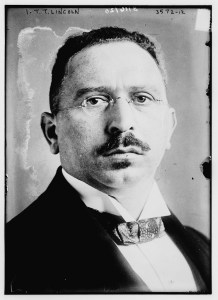
This is Ignatius Timothy Trebitsch-Lincoln.
Member of Parliament for Darlington. Buddhist abbot. Self-proclaimed Dalai Lama. Convicted con artist. Infamous spy. Nazi collaborator. Continue reading Ignatius: Father of John Lincoln
Bombardier John Lincoln was the eldest son of Ignatius Timothy Trebitsch-Lincoln. Born Natzl, he changed his name in order to distance himself from his father.
John has the rather dubious claim of being subject to the last civil execution to be carried out at Shepton Mallet.
On the evening of Wednesday 23 December 1925, John and another Royal Artillery Bombardier, Ian Stewart had been out drinking. They travelled to the Trowbridge home of Edward Richards, with the intention of robbing him. They both carried weapons because they believed that Edward kept a pistol. They entered Edward’s home and soon found the pistol.
When Edward arrived home from work he realised that someone had broken in. He fired a pistol into the kitchen – not with the intention to harm but in defence as he was in possession of a large amount of money belonging to the Brewery. John fired back. He shot Edward and then attacked him with an empty beer bottle.
Edward died in the early hours of Christmas Eve, soon after reaching hospital.
John and Ian were arrested on Christmas Day and were tried for murder on 19 January 1926. Ian was acquitted of murder but was sentenced to 14 years for burglary. John was found guilty of murder and sentenced to death.
On 1 March 1926 John was visited at Shepton Mallet Prison by his fiancée, Miss Lily Brown of Trowbridge, Lily’s brother, John’s brother Lincoln and his mother, Gretchen. His estranged father wasn’t present – he was still en route from Sri Lanka.
On the morning of 2 March 1926 John Lincoln had breakfast, played (and won) a final game of crib and then, at 8am, went to the gallows.He remains buried in plot seven inside the walls on the west side of the prison.
Did you know…?
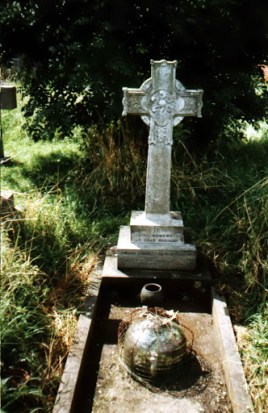
Edward Charles Ingham Richards lived in Trowbridge with his wife and child.
He was a traveller, employed by Usher’s Wiltshire Brewery.
His life came to a sudden end in the early hours of Christmas Eve 1925 as a result of the drunken actions of Bombardier John Lincoln and his accomplice Ronald Stewart. He was aged 25 years.
Edward was respectfully laid to rest in North Bradley churchyard, Wiltshire.
John Lincoln went to the gallows and was buried in unconsecrated ground in an unmarked grave within the walls of Shepton Mallet Prison where it remains to this day.
[Photo from Disney, 1992]
Published on 20/03/16 @ Creating a Vision and Future for Shepton Mallet Prison

